
How to Memorize Anything Quickly: 5 Techniques for Presentations and Speeches
Have you ever been in a high-stakes meeting and felt that chill down your spine because you couldn’t memorize presentations fast enough to recall the next line? For the entrepreneur or high-performance professional, this “blank” during a speech is more than an annoyance; it’s a critical system failure in the most expensive hardware you own: your brain.
If you’re over 30 and feel your retention capacity isn’t what it used to be, science has an explanation—and a solution. It’s not about “rote memorization,” but about optimizing the encoding and retrieval of information.
In this ReviewLab.click guide, we’re deconstructing 5 elite techniques to master your delivery, allowing you to speak with absolute authority without leaning on slides or notes.
Why Do We Forget Our Lines?
The Biology of the “Blank”
What causes memory lapses under pressure?
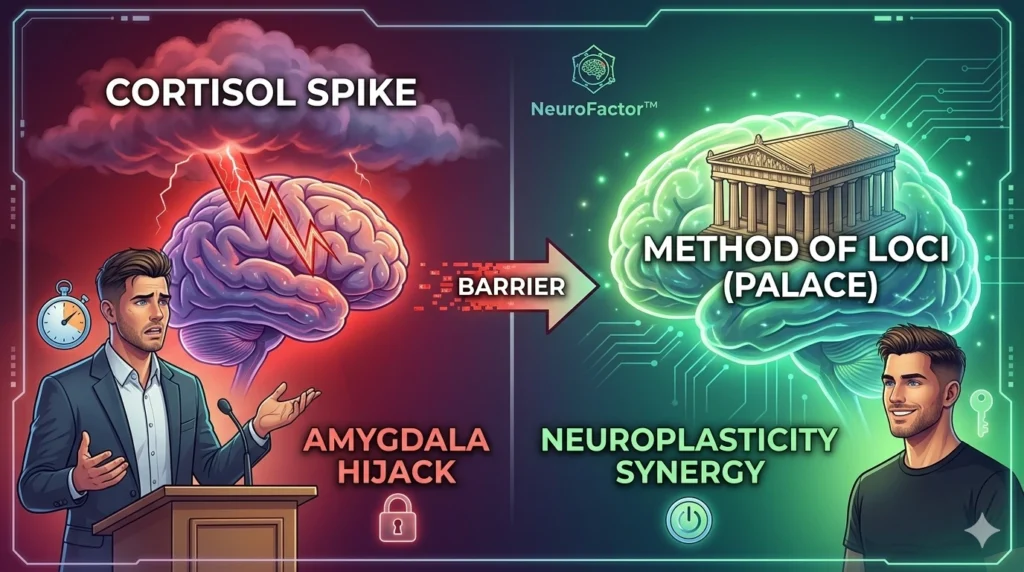
The “blank” during a speech is actually an amygdala hijack. When cortisol (the stress hormone) spikes, it inhibits access to the hippocampus—the region where long-term memories are retrieved. For a biohacker, understanding that the brain “locks up” due to overload or inflammation is the first step toward control.
Learning how to memorize presentations fast can transform your performance in high-stakes meetings and public speaking.

1. Technique : The Memory Palace (Method of Loci)
How to use the Method of Loci for long speeches?
Used since Ancient Greece by orators who spoke for hours, the Method of Loci leverages our evolution: we are much better at remembering places than words.
- The Technique: Visualize a path you know well, such as your house or your office in the Carboniferous region.
- The Application: “Deposit” each key point of your speech on a specific piece of furniture or within a room.
- The Scientific “Why”: You are linking semantic memory to spatial memory, creating a much more robust neural pathway.
- If your reasoning feels too slow to build these paths, it might be a sign of low synaptic efficiency. Learn how how to fix slow reasoning to fine-tune your hardware.

2. Chunking: Mastering Working Memory Capacity
How does the brain process high volumes of information?
The average human brain can only hold about 4 to 7 “units” of information in working memory. Attempting to memorize 20 isolated topics will cause a system overwhelm.
- The Technique: Break your speech into 3 main blocks (e.g., Problem, Solution, Call to Action). Within each block, have only 3 sub-topics.
- The Benefit: This reduces cognitive load, allowing you to focus on delivery rather than the effort of remembering.
Performance Insight:
Managing these blocks of information requires high neural bandwidth. If you feel your brain “runs out of RAM” during this process, consider auditing your metabolic support.

3. Self-Explanation and the Testing Effect
Why is rereading your script inefficient?
Passive reading is one of the biggest mistakes in high-performance preparation. Neuroscience shows that Active Recall is what truly strengthens synapses.
- The Technique: Read a topic once, then close your eyes and explain it to yourself out loud as if teaching a colleague.
- The Scientific “Why” (Neuroplasticity): By forcing the brain to retrieve information, you signal that the data is vital, physically consolidating the neural pathway.
4. Emotional Anchoring and
Exaggerated Visualization
How to make technical data memorable?
The brain is programmed to discard “boring” information. To memorize cold statistics in a presentation, you must create an emotional or absurd “hook”.
- The Technique: Use the Number-Shape System. If you need to remember that profits rose 22%, visualize two giant ducks (the number 2) swimming in a pool of gold coins.
- The Scientific “Why” (The Trigger): The more absurd or vivid the image, the easier it is for the brain to encode the data via the amygdala and the limbic system.
- The Benefit: You transform abstract numbers into “high-priority” data that the brain refuses to delete.

5. Deliberate Practice and Consolidation Sleep
What is the role of sleep in memorizing presentations?
Memorization doesn’t happen while you study; it happens while you sleep. During REM and Deep Sleep stages, the brain clears metabolic waste and moves information from short-term to long-term storage.
- Pro Tip: Practice your speech one last time before bed. This activates the Recency Effect, signaling the brain to prioritize this specific content during overnight consolidation.
- The Science: This process is known as Synaptic Scaling, where the brain “prunes” irrelevant data and strengthens the neural pathways you just used.
FAQ – Memory Biohacking
Conclusion: Optimizing Hardware Beyond Techniques
Memorizing a high-impact presentation requires efficient technique, but even the best software fails on degraded hardware. If you feel that despite using these methods, your mind still feels “cloudy,” the issue may be neurochemical.
For executives and professionals who cannot afford to fail under pressure, intelligent supplementation with specific nootropics and flavonoids has proven to be the difference between mental fatigue and absolute clarity.
To understand how to provide the necessary nutrients for these neural connections, check out our scientific deep dives: